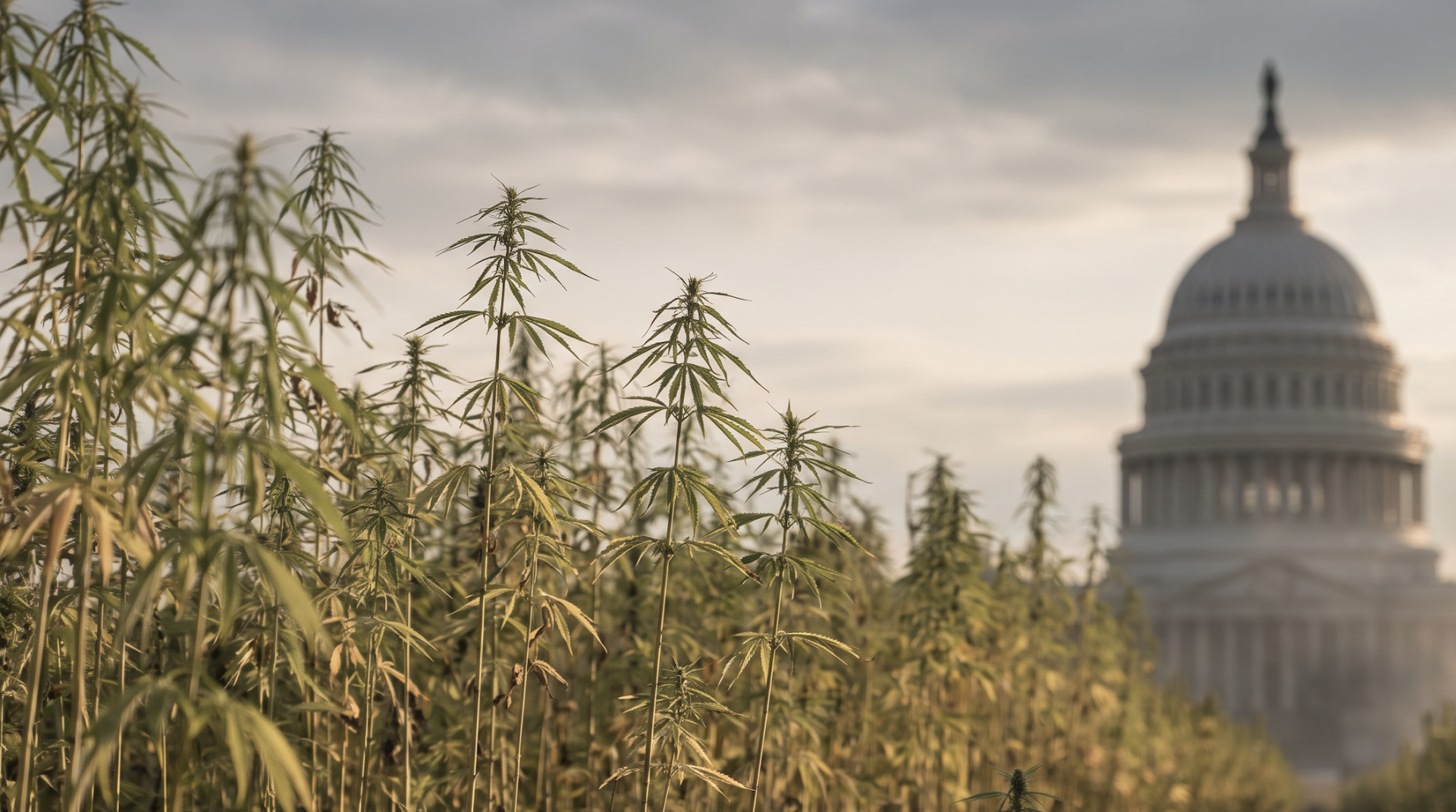
By now, there is little disagreement within the cannabis industry that federal hemp policy needs to change.
When Congress legalized hemp through the 2018 Farm Bill, lawmakers created a new agricultural commodity but left many questions unanswered about the products that could be made from it. With this ambiguity, intoxicating hemp-derived cannabinoids found their way into gas stations, smoke shops, and online marketplaces and were often sold without needed age-gating and consumer education.
This prompted Congress to act but resulted in a pendulum swing too far in the opposite direction. Unless lawmakers reach a permanent agreement before the temporary extension expires in December, new federal restrictions could fundamentally change which hemp products remain on the market.
The debate in Washington has largely centered on intoxicating cannabinoids. But hemp is no longer a niche crop or a single product category. It supports grain and fiber farmers, CBD manufacturers, food companies, textile producers, building-material manufacturers and a growing market for low-dose hemp beverages.
Each operates under a different business model, yet much of the federal discussion has treated the industry as though it presents a single regulatory challenge.
Rather than asking whether hemp should face greater oversight, a growing number of industry leaders are asking a different question: What should a permanent federal hemp framework actually look like?
One proposal emerging from that discussion is the Goodness of Hemp Act.
Developed by a coalition of hemp stakeholders, the draft framework would regulate hemp according to product type rather than under a single set of rules. Industrial hemp would be treated differently than cannabinoid products. Oversight would be shared among the U.S. Department of Agriculture, the Food and Drug Administration and the Alcohol and Tobacco Tax and Trade Bureau, depending on the product category. The proposal also includes provisions intended to expand industrial hemp markets, including companion animal feed, while directing funding toward research and market development.
The framework arrives at a moment when Congress appears to be weighing several different paths forward. Congress recently approved a short-term extension that delays implementation of the pending federal hemp restrictions until December, giving lawmakers additional time to negotiate a permanent solution. While the extension provides temporary relief for businesses facing an uncertain regulatory future, it also underscores that Congress still needs to decide what a lasting federal hemp framework should look like.
Some lawmakers have introduced legislation that would give states more flexibility. The Goodness of Hemp Act offers a broader regulatory blueprint instead of another temporary extension.
“From a business perspective, the Goodness of Hemp approach changes the question from ‘Can this industry survive?’ to ‘How can this industry be responsibly regulated and scaled?'” said Geoff Whaling, chairman of the National Hemp Association.
For many businesses, the issue extends well beyond whether a particular product remains legal. Long-term investments in manufacturing, agriculture, and consumer brands depend on having predictable rules.
Howard Lee, CEO of SōRSE Technology, believes a comprehensive framework could provide that stability.
“This will finally provide the framework for legitimate business to supply, manufacture and sell hemp products,” Lee said. “It will also allow banks, investors and companies to invest in the legitimate industry leaders.”
That perspective reflects a challenge facing many companies across the hemp supply chain. Farmers decide what to plant months before harvest. Manufacturers commit capital years before a facility begins operating. Retailers build product categories expecting consistent rules. While businesses can adapt to regulation, uncertainty makes long-term planning far more difficult.
Supporters of the Goodness of Hemp Act argue that a clearer federal framework would provide that predictability while also giving regulators stronger authority to remove unsafe products and enforce consistent standards across the marketplace.

Morgan Tweet, executive director of The Hemp Feed Coalition and co-founder of IND HEMP, said the extension passed last week in a spending bill was an important first step but that the industry ultimately needs a permanent policy that provides certainty across every segment of hemp.
“The extension was necessary and provides Congress with a little more time to really fix some of the biggest issues facing the hemp industry. We need a policy that supports American farmers, protects consumers, encourages innovation and gives responsible businesses the certainty they need to invest for the long term. I’m hopeful that policy will come to fruition before the new December deadline.”
Tweet said the Goodness of Hemp framework could also reshape how investors and manufacturers view the industry’s future.
“If Congress were to enact a comprehensive framework like the Goodness of Hemp, it would send a powerful signal that hemp has a long-term place in American agriculture and manufacturing. That kind of certainty unlocks investment because businesses can finally make decisions with confidence that the rules won’t change overnight.”