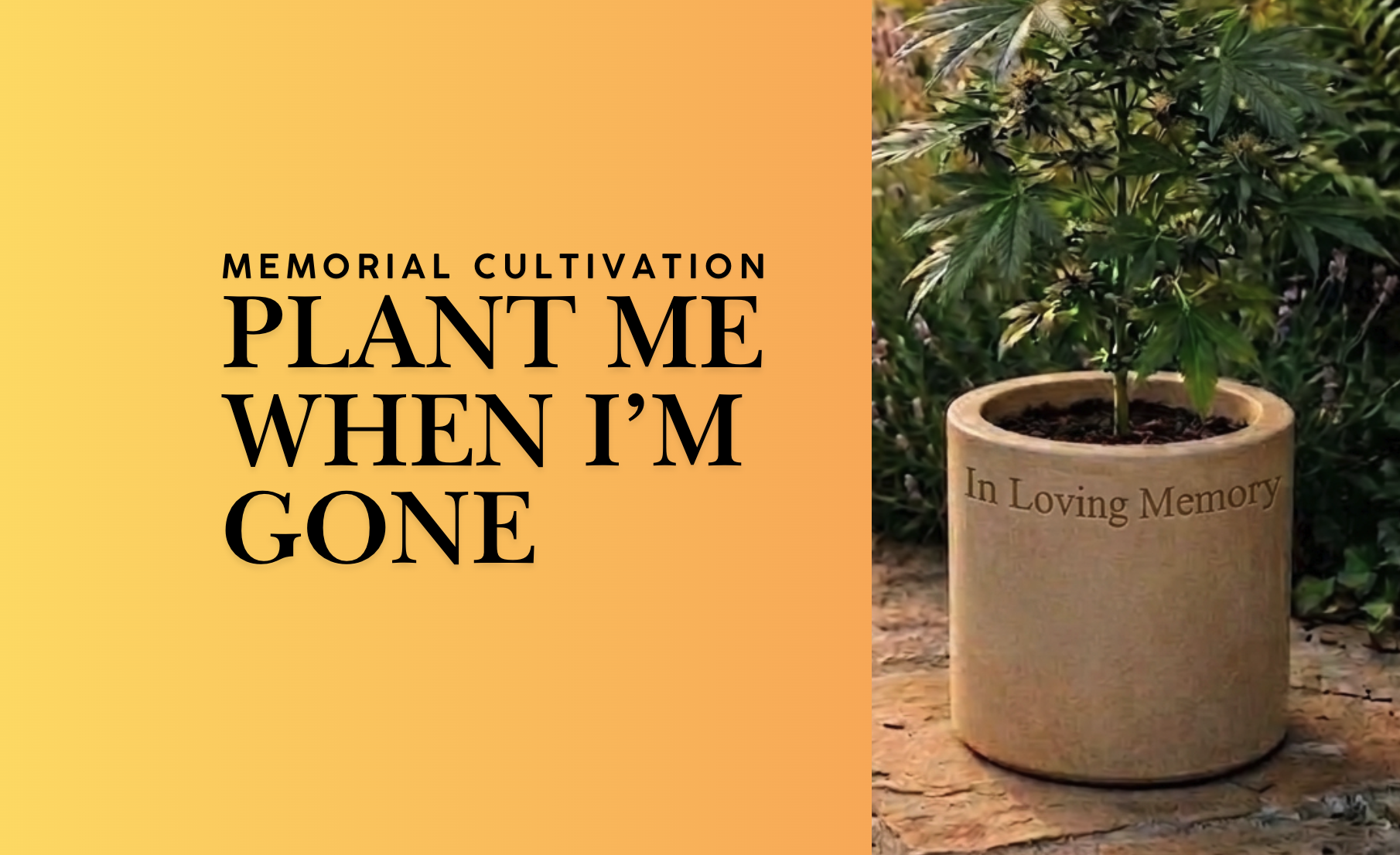
Anyone doing end-of-life planning faces decisions about their time, their belongings, and their relationships. Some of them are now making one more decision: what kind of memorial they want to leave, which strain to represent them, and setting the whole thing in motion while they are still alive.
That is the actual story behind memorial cultivation as a product: not a family scrambling to do something meaningful with a loved one’s ashes, not a posthumous gesture assembled by the grieving. While living, a person purchases a memorial kit, chooses a seed or clone strain, names the grow steward, and creates a digital memorial page. They also prepay for a subscription that will carry the grow and the memory forward. It is a final gift arranged with the same intentionality as every other end‑of‑life decision.
The family grows the plant at home, and the memorial platform continues indefinitely, in every state, regardless of what grows in the planter.
Three Trends Walking Into the Same Room
The natural and green burial market is projected to grow at a high single‑digit compound annual rate. Consumers are rejecting embalming, concrete vaults, and synthetic cemetery turf. They want something living, cyclical, and meaningful.
As of early 2026, adult‑use (recreational) cannabis is legal in 24 U.S. states plus Washington, D.C., and medical cannabis is legal in 40 states plus D.C. The stigma that once kept cannabis out of serious end-of-life conversations has largely eroded among the same demographics actively rethinking how they want to be remembered.
Platforms built around digital legacy – storing a person’s story, linking physical objects to biographical data, preserving a life in navigable form – are growing alongside the broader death‑positive movement.
What does not exist yet is a digital legacy platform built specifically around a living grow.
Overlay all three, and the product concept that emerges is simple: a physical planter, a biological vessel for ashes, a strain chosen by the individual while living, and a permanent digital memorial for family and friends tied to the grow from day one.
Plant Me When I’m Gone, Memorial Cultivation Kit
Strip away the sentiment and think about this as a product architecture.
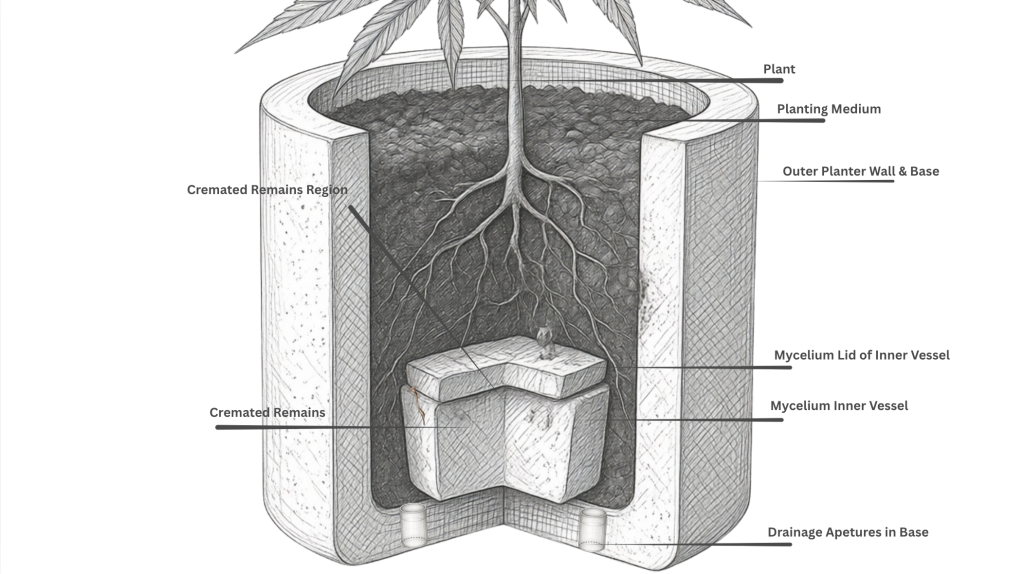
Plant Me When I’m Gone currently retails for $800. What comes in the kit: a hempcrete outer planter, a mycelium inner vessel, and a QR code permanently linked to the Digital Memorial Platform.
The ashes go into the mycelium vessel. That is not an optional feature or a ceremonial add-on. The vessel is the core of the product, and placing ashes into it is the act that transforms a planter into a memorial.
The vessel is closed and positioned below the primary root zone. That placement is intentional. Cremated remains are high in calcium phosphate and have an alkaline pH, and direct contact with a young root system can impede plant establishment. The planting medium sits above the vessel, giving the plant space to develop healthy roots first. As the biodegradable mycelium vessel breaks down under normal moisture conditions, it improves soil structure and nutrient availability in the root zone below. Over time, the roots grow down into that enriched medium. Over time, the roots grow down into that enriched medium. The plant grows from the person it honors. The design is engineered to make that possible without compromising the plant’s health.
The Memorial Cultivation Digital Layer
The Digital Memorial Platform is the subscription engine, built around how a home grow actually works. No sensors, no cameras, no hardware beyond the phone already in the family’s pocket.
The person who purchases the kit builds the foundation while living. Before death, they log into the platform, create their memorial page, write a biography, upload photos, name a designated grow steward, select their strain, and compose a series of grow‑locked messages. Those messages are held by the platform and released only when the family marks a grow milestone: seed planted, first sprout, canopy, first flower, harvest.
When the grow steward marks a milestone, that single action does three things at once: it releases the pre‑written message to the named recipient(s), adds the photo to the grow journal attached to the memorial page, and sends a notification to every family member with portal access.
Weekly check‑in reminders keep the journal active between milestones, creating a record visible to everyone the person authorized. Every photo, every milestone timestamp, every message delivered becomes part of the memorial record. The platform does not end when the first grow ends.
In home-grow states, the family continues from the same genetics indefinitely. In states that do not permit home cannabis cultivation, the same planter grows an herb, a flower, or any plant the family chooses. The digital memorial continues regardless of state law. The QR code on the planter does not expire.
The Licensed Medical Caregiver Question That Schedule III Opens
The kit and platform described above require no caregiver, no licensed operator, and no legislative change to function. They fit inside existing home‑grow and cremation frameworks. That is Phase 1, and it exists today. The question worth raising now is what Phase 2 could look like, and why Schedule III is what makes that conversation possible.
Designated licensed medical cannabis caregivers have spent years building deep relationships with specific strains for specific patients. They know the genetics. They know how a plant responds to a given patient’s needs. That knowledge has real value in the memorial context. A patient who wants their memorial grow to carry the exact strain that helped them while living has a reason to want that clone, not just any seed from a catalog.
The problem is legal, not horticultural. In many states, the pathway for a licensed cannabis caregiver to transfer a clone to a family member after the patient’s death is narrow to nonexistent. Cannabis plants and cuttings are controlled material. The authorization that gave the caregiver standing terminates when the patient dies.
Schedule III does not fix that directly. But it changes the environment in which that policy conversation happens. The caregiver industry has been in structural retreat for years, driven by commodity price collapse. For example, Maine lost more than 27.5 percent of its registered caregivers between 2021 and 2023. Michigan removed caregivers from the dispensary supply chain entirely.
A medical cannabis caregiver operating under normalized federal tax treatment, with legitimate business expense deductions and access to state‑chartered banking, is a more credible participant in a policy conversation about patient‑directed memorial grows.
The question that follows from Schedule III normalization is this: should a designated licensed cannabis caregiver be able to, with documented patient consent established in advance, hand off a clone of the patient’s chosen strain to the family for planting in the home memorial kit? That is not current law today in any U.S. state. It is a natural policy direction for advocates who want to give the cannabis caregiver industry a reason to exist that no MSO can replicate. The memorial grow is exactly that reason. No dispensary SKU captures what that transaction actually is.
The Industry Category Does Not Exist Yet – That Is the Point
At the consumer level, memorial cultivation is already taking shape as a category. At the industry level, it does not exist yet. “Memorial cultivation” is not a licensed designation. “Tribute grows” is not a SKU type in any compliance system. There is no session at MJBizCon titled “Building a Memorial Grow Program.”
That is not a limitation; it is whitespace.
Plant Me When I’m Gone is building in this space: the hempcrete planter, the mycelium vessel, the digital memorial platform, and the QR code that links the physical planter to the person. The consumer product comes first. Cultivator partnerships, operator integrations, and caregiver‑strain continuity conversations grow from the foundation the kit establishes.