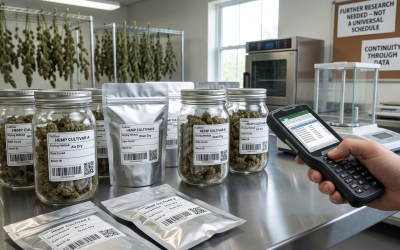

Section 781 is changing the landscape for breeders, seed suppliers, and online retailers, but many questions about how it will be implemented remain unanswered. For growers, one of the biggest concerns is whether they’ll still be able to access their favorite strains and buy them online.
To understand how customers view these changes, Herbies Seeds surveyed 432 U.S. customers in September and October 2026. We asked what they knew about Section 781, where they bought seeds, how attached they were to particular strains, what purchases they were planning, and what concerned them most. We supplemented the survey with a year of U.S. order data and findings from an earlier customer survey on pricing.
What Section 781 changes
In recent years, cannabis seeds have been openly sold online in the U.S., including across state lines. This was possible under the federal definition of hemp, which focused on the delta-9 THC content of the product itself. Because cannabis seeds contain little to no THC, they fell within that definition.
Section 781 of Public Law 119-37 changes that approach. Viable cannabis seeds are excluded from the federal definition of hemp if the plant that produced them contained more than 0.3% total THC, including THCA, on a dry-weight basis. What matters now is not the THC content of the seed itself, but the plant that produced it.
The new provision is not yet in effect: Public Law 119-103 delayed most Section 781 amendments until December 11, 2026.
What remains unclear
Section 781 does not establish a mandatory documentation format or verification procedure for sellers. How should the THC content of the seed-producing plant be verified? What happens to older seed lots without those measurements? What evidence will be considered sufficient, and what liability could market participants face? The statute does not answer these questions.
Customers are also struggling to understand the new rules. Some 38.7% of respondents had never heard of Section 781. When asked which THC measurement matters under the new provision, 50.7% answered “I don’t know,” while only 12.7% correctly identified the plant that produced the seeds.
Much of the seed catalog could be at risk
Over the past year, CBD-focused strains (low-THC varieties) accounted for just 1.6% of seeds Herbies sold in the U.S. All other strains made up 98.4%. Most of the commercial catalog is geared toward growing high-THC plants, meaning the new restriction could affect a major segment of the market rather than a small niche.
Buyers are loyal to specific genetics
If customers were happy to switch between strains, changes to the available selection would be easier to manage. But the survey suggests that substitutions won’t work for everyone.
The most common concern was losing favorite strains or having fewer options, cited by 45.4% of respondents. Rising prices concerned 38.2%. Respondents could select more than one answer.
When asked whether they would replace a favorite strain with a similar one, 47.9% said it depended on the strain.
Order data adds another dimension: more than four in ten repeat U.S. customers purchased at least one strain with the same catalog name again, with at least seven days between orders. The data does not explain why customers returned, but it does show repeat demand for specific strain names.
Why online access matters so much
Three-quarters of respondents (75%) buy almost all their seeds online, while another 12.3% buy most of them online. Together, that’s 87.3%. U.S.-based online seed sellers were among the usual sources for 80.3% of respondents.
Among customers who buy most or almost all their seeds online, 67.4% said it would be difficult to find a particular strain in their state if they could no longer order it online. The problem is especially pronounced in states without adult-use legalization: 62.3% of respondents in those states said finding the strain locally would be very difficult or impossible, compared with 30.3% in states with adult-use legalization.
For many customers, an online seed store is a way to access specific genetics they simply cannot find nearby.
Could the seed market become more local?
Once Section 781 takes effect, seeds produced by plants containing more than 0.3% THC may fall under federal regulations governing marijuana as a controlled substance. Sellers would then be unable to continue shipping those seeds across state lines under the same conditions as before.
If interstate shipments of part of the catalog become restricted, businesses may have to explore different models: working with local breeders, building regional partnerships, and rethinking where they sell.
Customers already anticipate these difficulties. Some 45.4% believe high-THC genetics will become harder to obtain within a year of the rules taking effect.
But a local-market model will not work equally well in every state. Rules for producing and selling seeds vary, and states without adult-use legalization may have no legal local alternative at all. These are also the states where respondents were most likely to say a strain would be very difficult or impossible to find without ordering online.
Moving from large online retailers to local warehouses could therefore involve much more significant changes, including a restructuring of relationships between breeders, distributors, and retailers.
Could seed prices rise?
Additional costs could come from plant testing, verifying and maintaining documentation for individual seed lots, legal support, and changes to logistics. These expenses could be especially significant for smaller breeders and suppliers, and businesses would likely pass at least some of those costs on to customers.
Buyers already expect higher prices: 58.8% of respondents believe seed prices will rise. But their willingness to pay has limits.
In an earlier Herbies customer survey conducted in early 2026, we asked how much respondents would be willing to pay for a three-seed pack of a strain they really wanted. Some 55.4% named a price of $30 or less, another 25.7% were willing to pay between $30 and $40, and only 18.9% would pay more than $40.
Meanwhile, the typical price of a three-seed pack in Herbies’ U.S. orders over the past year was approximately $32.
In other words, current prices are already close to the upper end of what most customers are willing to pay, even for a strain they really want. A significant price increase could have a greater impact on demand than customers’ expectations alone might suggest.
What this could mean for the industry
For breeders: New challenges in reaching customers. If interstate shipping becomes more difficult for some seeds, regional production and distribution partners may be needed. Documentation of individual seed lots and their origins will also become more important. Some 28.7% of respondents believe small breeders and seed banks will have the hardest time adapting, although that reflects customer expectations rather than a confirmed forecast.
For online retailers and platforms: More complex catalog management. Instead of offering one nationwide catalog, businesses may need to manage product availability on a state-by-state basis. What matters will not be just the strain name, but also the specific seed lot, its documentation, and whether it can be shipped to the customer’s address.
For suppliers and retailers: More paperwork and logistical challenges. If established supply routes become restricted, businesses will need to find new partners, verify seed-lot records, and expand their presence in individual states where local laws allow it.
The bottom line
Section 781 could push the cannabis seed market toward a more regional model. If interstate trade becomes harder for part of the catalog, access to specific strains will depend more heavily on local producers, retailers, and state laws.
For breeders, that means new ways of reaching the market. For suppliers, it means rethinking logistics and product selection. For online retailers, it means accounting for regional restrictions.
For growers, the most noticeable consequences could be less choice and higher prices. If a favorite strain is not available through a legal market they can access, getting it online could become significantly more difficult.
Methodology
Herbies Seeds, an online cannabis seed marketplace, conducted a survey of its U.S. customers through its own online survey platform from September 1 to October 12, 2026. The analysis includes 432 responses from customers who reported being located in the United States.
The research also used U.S. order and pricing data from Herbies’ internal sales and financial reporting systems, covering September 1, 2025, through August 31, 2026.