Table of Contents
From craft-only to software-assisted cultivation
For decades, cannabis cultivation has been driven by “art plus experience.” A head grower walks into a room, feels the air, reads the canopy, checks color, posture, and smell, then makes calls on irrigation, defoliation, and environmental tweaks based mainly on intuition and memory. That craft still matters, but in a modern hybrid greenhouse, it is now layered on top of a digital, automated foundation rather than standing alone.
In a data-rich facility, subjective observations are backed by charts and trends. Instead of a vague sense that a room is running dry, teams can view substrate moisture, EC, and drain curves by cultivar and bench, and adjust shot size or timing with greater confidence. The grower’s expertise becomes a strategic layer on top of verifiable data rather than the sole source of truth.
The physical layer: a tech-ready hybrid shell
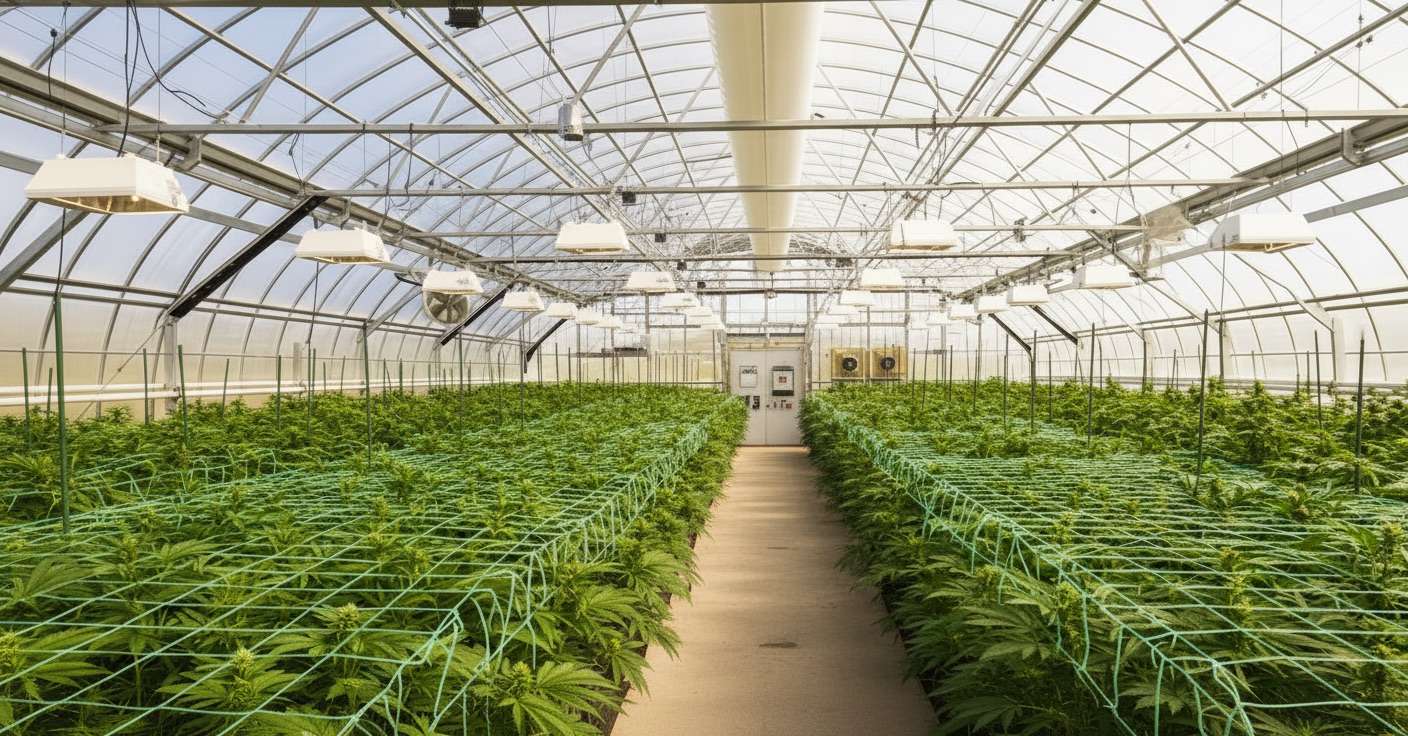
In cannabis, “hybrid greenhouse” now means more than a glasshouse with blackout. It usually refers to a semi-closed or tightly controlled structure that operates between a traditional greenhouse and an indoor facility with light-deprivation.
Common characteristics include:
- Semi-closed or positive-pressure designs with integrated dehumidification, cooling, and CO₂, instead of relying mostly on vents and fans.
- Zoned layouts with distinct microclimates for veg, flower, mothers, and sometimes vertical or mezzanine levels, all connected to central mechanical and fertigation systems.
These physical decisions set the boundaries for what automation and AI can achieve. If a shell cannot hold stable temperature, humidity, and CO₂ ranges, no advanced controller will fully overcome that limitation.
Forward-looking cannabis projects also design the structure to be “automation-ready.”
- Conduit, cable trays, and sensor rails are built in so cameras, sensors, wireless nodes, and other hardware can be installed or repositioned without major reconstruction.
- Roofs, glazing, and light-deprivation systems are selected with both plants and software in mind, allowing motorized shades, blackout curtains, and LED rows to function as a coordinated lighting system.
The digital layer: sensors, controls, and the grow data lake
Once the shell is in place, the real operating system of a hybrid greenhouse is the control stack. Climate computers, fertigation controllers, and IoT platforms turn the facility into a continuous stream of measurements and actions.
On the controls side, cannabis operators often standardize on:
- Climate and irrigation platforms such as Argus, Ridder, or Growlink, which connect heating, cooling, dehumidification, vents, CO₂, irrigation valves, and sometimes lighting under a single supervisory interface.
- Cannabis-focused data and crop-steering platforms such as AROYA, which collect substrate moisture, EC, drain, and environmental data into dashboards designed around recipes, setpoints, and cultivar comparisons.
On the sensing side, advanced greenhouses are effectively wrapped in a digital nervous system.
- Canopy-level temperature and humidity sensors show what plants actually experience rather than relying only on a single reference sensor.
- PAR/PPFD sensors track the interplay of sunlight and supplemental LEDs across seasons and bays.
- Multiple CO₂ sensors per bay, substrate moisture and EC probes, flow meters, and line-pressure sensors validate that irrigation strategies are being executed as intended at the dripper.
All of this information feeds into a central “grow data lake,” typically cloud-hosted and accessible through dashboards and APIs. Over time, that data becomes a historical record of how each cultivar and room responds to specific environmental and irrigation strategies, enabling cross-batch and cross-site benchmarking.
Why the data lake matters for MSOs
- Enables performance comparisons across states and facilities for the same genetics.
- Helps correlate compliance issues, such as microbial failures, with environmental or irrigation anomalies.
- Strengthens the investor narrative by showing that cultivation is managed as a measurable process, not a black box.
The intelligent layer: AI, ML, and computer vision
Once a greenhouse is fully instrumented, the next logical step is to add an intelligent layer. AI and machine learning start turning raw data into predictions and automated decisions.
AI for climate and irrigation
AI-driven climate control is emerging in both general horticulture and cannabis-focused offerings. These systems learn from historical crop data and weather forecasts to fine-tune:
- Heating, cooling, and dehumidification in a way that reduces swings instead of merely reacting after they occur.
- Venting and CO₂ dosing to preserve conditioned air and maintain stable setpoints more efficiently.
On the irrigation side, platforms like AROYA and other advanced engines are driving toward AI-guided crop steering. Instead of fixed timers, the system looks at real-time substrate moisture, EC, and drain curves, plus historical performance, and then:
- Adjusts shot size and timing to hit targeted dry-back profiles.
- Supports more generative or more vegetative steering depending on cultivar and stage.
The cultivation team defines goals and boundaries, while the system handles granular execution and records every change.
Vision systems and robotics
Computer vision is becoming the third pillar of intelligent greenhouses. Vendors like IUNU deploy rail-mounted camera systems that continuously scan the canopy and build digital representations of plants or sections. These systems highlight:
- Uneven canopy development or lagging plants.
- Early nutrient issues and subtle stress patterns.
- Hot or cold spots that might not be obvious from a limited sensor array.
Some cannabis operators also experiment with Raspberry Pi cameras and YOLO-style models to automatically detect pests or powdery mildew, turning visual scouting into a continuous digital signal rather than a manual once-a-day walk-through. Autonomous or semi-autonomous robots are starting to appear as mobile platforms for these sensors and cameras, handling repetitive scans and feeding more data into the system.
Business outcomes: grams, cost, and compliance
Automation, sensing, and AI are gaining traction in cannabis greenhouses because they move core business metrics.
Operators that adopt advanced controls and data platforms typically aim for:
- More stable yields and tighter potency and terpene ranges as environmental and irrigation variability declines.
- Lower labor costs as climate and irrigation management shift from constant manual intervention to exception handling and strategic tuning.
- Reduced crop-loss risk, since emerging issues are flagged earlier through sensor trends and computer vision rather than only through catastrophic symptoms.
On the compliance side, automated systems generate detailed logs of environmental conditions, irrigation events, nutrient recipes, and sometimes plant-level health indicators. These records support GACP/GMP-aligned processes and make audits and inspections more straightforward. For MSOs, this same dataset underpins a stronger capital markets story, positioning cultivation as a scalable, measurable manufacturing platform rather than a personality-dependent craft operation.
Takeaways for CannabisTech readers
For CannabisTech.com’s audience—operators, facility designers, and technology vendors—the hybrid greenhouse is best viewed as a three-layer technology stack.
- The physical layer defines the climate envelope and mechanical capabilities.
- The digital layer turns that envelope into rich, continuous data streams.
- The intelligent layer converts those streams into decisions, automations, and early warnings.
Vendors such as Argus, Ridder, Growlink, AROYA, and IUNU already provide key components of this stack, and cannabis projects that want to stay competitive increasingly expect these systems to integrate cleanly. The operators and technology partners that treat all three layers as part of one design problem are the ones most likely to capture the next wave of efficiency, consistency, and compliance advantages in hybrid cannabis greenhouses.